Showing posts with label MEC research finance and stocks. Show all posts

Wednesday, February 2, 2011

Sugar spikes on futures trading re: Australian cyclone - damage to sugar plantations

And we still have riots/turmoil in the middle east, namely Egypt; which on all reports started or was ignited by the cost of food and living expenses increasing. Now with sugar spiking, also not to forget meat exports to the middle east falling off from Australia (also related to cyclone 'Yasi'), which in turn will effect meat/live export futures (upward price spikes). Flash point tensions (middle east) could get far worst as the inflation squeeze on food will now exasperate from natural disasters that have hit Australia.


+1.35 +3.98% Volume 80,122 Feb 2, 2011, 1:59 p.m. Previous close 33.93 ¢ 35.28 ¢ Change +1.35 +3.98% Day low 34¢ Day high 36¢ Open: 34.10

Tuesday, February 1, 2011

Cataogory 5 Cyclone "Yasi" about to hit East Coast Australia (Queensland) - update 1


USA and Cyclone 'Yasi'

Size composition for scaling (examples). Please go here for rest of set

Cataogory 5 Cyclone "Yasi" about to hit East Coast Australia (Queensland)

After the devastating floods in January 2011, now comes this monster cyclone:

Monday, January 31, 2011

Oil (Brent) breaks $100, oil up on risk aversion (Middle East)

Basically the middle east is heading into credit contagion, which means the longer there is uncertainly in that region, i.e civil unrest/political turmoil, credit spreads will widen and the costs to insure sovereign debt will blow out too. With Egypt's CDS spread widening to 4%, at the cost of $440,000 on 10 million (Sovereign Debt), at this point one has to expect, even with a possible China inflation crash scenario, that has spooked markets in the last week (note oil/gold under pressure). A follow on from China's inflation issue is the serious problems now occurring in the middle east, this will then feed back into the inflation problems of Asia/China etc. We are now in a extreme economic game changer, with oil/food prices spiking. Further oil prices may cause China to react. How? Well, if the US continues on a path of US dollar deprecation, China will force the interest rate hand and sell US Treasury's. They will do this quickly and spike up USD's and UST yields, with the 10yr going well over 5%, and a pressure the US fiscal policy to tighten. This will be forced upon the US by China.

As discussed in Oil on a 25mth cyclical bull run, China is a net importer of oil, that and they are hall-marks of hyper inflation ( eg tea price one week is a certain price, next week it goes up again). Oil (WTI) starts to head towards $95, at any case over $90, it will be a breaking point for China in it's inflation dilemma.

The other option? China crashes a potion of it's economy, say housing.

In the meantime, oil is going upward.

Note the narrowing Brent/WTI spread

Thursday, January 27, 2011

Market correction imminent, Gold/Copper correlation corrections due (update 4) - SPDR Gold ETF sell off

Good to track against the Gold price, with rumored huge stop losses at $1300, a capitulate sell thereafter. If the ETF market collapses could see sells shift into other ETF commodity markets.

Market correction imminent, Gold/Copper correlation and corrections due (update 3) - sell signal on Gold

As discussed in Market correction imminent, Gold/Copper correlation and corrections due (update 2) if gold was to break the low of 1361 it was destine to enter a sell signal thus correction.

This has nothing to do with global economy improving or risk approving meaning shares are attractive, instead what we are entering into is a commodity correction most probably stemming from China i.e fears of hard landing.

Watch all risk crosses for unwinds, continued stock pressures emerging markets.

Wednesday, January 26, 2011

Panic trades coming up: major oil, copper, gold, stock corrections (update 1)

  • Cocoa re: current political turmoil and export bans. Cocoa price London futures (sterling: 2191). In June 2010 a hedge fund called Armajaro Holdings tried to 'corner' market, it played a risk hand and got burned - as the Cocoa price collapsed. Good to watch for price spikes via hedge fund plays and potentially crashes.
refer to July 2010 Armajaro Holdings play that went south as the market squeezed out huge 'cornered positions'

On July 16, Anthony Ward’s Armajaro Holdings attempted to corner the world cocoa market by taking delivery of 7% of the world’s physical supply when prices were at a 32-year high of $3,200/tonne.


The 240,100 tonne purchase was the largest in 14 years and spooked end users who were convinced Armajaro’s move would cause a supply squeeze just as confectioners were gearing up for increased holiday season production.

After the news broke, Tim Spencer, a former Armajaro executive, told the New York Times that, “Globally, [Ward] is unmatched in his knowledge of cocoa.”

Eugen Weinberg, an analyst at Commerzbank in Frankfurt, told the paper that “The squeeze was really timed perfectly.”

And Juergen Steinemann CEO of Barry Callebaut, the world's biggest chocolate maker told the Financial Times, "If you consider the fundamentals, I'd tend to say prices won't fall. There's no fundamental reason why cocoa should become cheaper."

But, at the time, Shawn Hackett, president of Hackett Financial Advisors, a money management firm with a focus on agricultural commodities, told Minyanville that he had quite a different outlook.

“Every once in a while someone attempts to do this. It’s always a huge failure and never works,” Hackett said. “I couldn’t be more bearish on cocoa, especially after this news.”

Hackett noted that, “the market will force [Ward] out of that position and cocoa prices will likely fall substantially from here.”

He continued, “I think we’re going straight down in the cocoa market. There are other speculators out there who can short the cocoa market and make a fortune. The hedge fund community doesn’t care about each other, they care about making money. They’re probably thinking, ‘Okay, now this guy is on an island, we can go short, hammer this thing down, and blow him out.’ Then that starts triggering stop losses, there’s a cascading effect, his equity is then falling and falling and falling…I can just see this guy getting totally ruined.”

Turns out, Hackett was right.

Armajaro’s mammoth play didn’t cause the sky to fall, nor did cocoa prices go through the roof. In fact, quite the opposite occurred, as prices have dropped 26% since.


The Wall Street Journal now reports that “Two hedge funds run by Armajaro, including its CC+ Fund, which focuses on cocoa and coffee, lost about 6% of their value during the first two weeks of August, according to investors who have viewed the returns. And since then, prices have continued to decline, suggesting Mr. Ward could be coming under more pressure.”

Hackett explains what investors can learn from the “Great Cocoa Scare of 2010”:

When you see a dramatic purchase like this, it almost always signifies a near-term panic buy that is associated with a major high point in a market. You see it periodically, like with cotton in early ’08. There was a rush of panicked buying right before the market changed direction, and several end users that had been around for years and years went bankrupt. Ford (F) panicked about palladium 10 years ago when it went from $200/oz to $1200/oz and bought up massive quantities for catalytic converters. "Let’s not take any chances -- we need this stuff." Well, it just went straight down to $400 after that.


According to Hackett, the pattern is always the same.

It’s unbelievable. You hear it over and over again -- "This time it’s different, this time it’s bullish," but it never is. It inevitably ends in disaster. It’s always been a clear topping signal, a quintessential contrarian indicator, and when you see this happen, either get out of a long position or go short. Cocoa was at $3200/tonne when the announcement came out, Monday morning it was down to $2950/tonne. There was a brief rebound rally, and now it’s down to $2700/tonne. And it’s all happened literally since that supposedly bullish indicator.


A near-term bottom will likely be established “the minute you hear Armajaro’s out completely,” says Hackett. “When somebody blows a position out like that, the overhang of the market is gone -- it takes all the psychological pressure off, there’s no one there to pick up the slack, and the buyers come rushing in.”

Hackett maintains that “during much of the rally that many thought was fundamentally-based, it was obviously artificial demand. It just wasn’t moving up for the right reasons.”

Companies like Hershey (HSY), Tootsie Roll (TR), Kraft (KFT), and even Archer Daniels Midland (ADM), which processes cocoa for manufacturers globally, could benefit from the move down in cocoa.

“Buying at 20, 30% lower prices should help improve margins going into 2011, at least on the input cost for cocoa,” Hackett says.

“In the Armajaro case, as typically happens, the true investment opportunity was to do exactly the opposite of what seemed logical. It’s very hard to do, it never feels comfortable to do what everyone else isn’t, but if you want to realize a return that’s better than most, you have to do something that’s different than most."

Monday, January 24, 2011

Inflation: global food blowout 2011

It begins: similar to 2008 when inflation spiked on food and oil.

from WSJ 25/01/2011

"Fast-growing emerging nations are taking increasingly aggressive actions to beat back rising food prices as they grow more worried of threats to stability if prices don't start to retreat.

Developing-market governments have unveiled a laundry list of measures—including price caps, export bans and rules to counter commodity speculation—to keep food costs from disrupting their economies as price spikes that some had hoped were temporary have stretched into the new year. Some economists worry that any further supply shocks could push prices even higher, triggering a food-price crisis like the one the world witnessed in 2008, when higher food costs led to violent unrest across the developing world.

Workers handle rice sacks in Jakarta. Rice prices remain below highs in 2008, when higher food costs caused unrest across the developing world.

FOOD

In the latest indication of concern, Indonesia said Thursday it will remove import tariffs on more than 50 items including wheat, soybeans, fertilizer and animal feed in an effort to slow the rise in food prices. Indonesia is also planning to raise taxes on palm-oil exports to 25% from 20% next month, according to a government official familiar with the matter.

Bad weather, more-affluent populations and underinvestment in agriculture have pushed up prices of everything from wheat, rice and onions in India, chilies in Indonesia and water spinach in China. Some point to low interest rates in the U.S., Japan and Europe, as investors use cheap financing to invest in globally traded commodities such as rice, sugar, cotton and oil, driving their prices higher. Soy bean prices in the past six months have risen 46% to more than $14 a bushel at the Chicago Board of Trade. Sugar, while lower than in November, is still up 34% over six months ago to around 31 cents a pound in IntercontinentalExchange trading.

In response to the price pressures, India earlier this month extended bans on exporting lentils and cooking oil. It also struck a deal with archrival Pakistan to import 1,000 tons of onions, a key cooking ingredient whose price has skyrocketed after floods.

China and several countries in the Middle East have instituted or strengthened ongoing price controls. South Korea has lowered import tariffs on some foods. Indonesia has been encouraging its citizens to plant chilies to boost supply."

Wednesday, January 19, 2011

China inflation breakout invertible - Societe Generale

Good thing about Societe Generale is back in November 2009 they warned about a sovereign lead global collapse (debt crisis) way before most banks even wanted to except the idea that Europe was a debt burden basket case, with a structurally bankrupt banking system. So it is probably wise to take notice when they issue a report, even though the hallmarks off hyper-inflation are creeping up, all it will take (as discussed on MEC research) is oil to maintain it's $90+ presence and food inflation from natural disastrous floods (southern hemisphere), droughts (northern hemisphere) to become something very serious for China.

From Business Insider 19/01/2011

"China's leadership has not properly addressed their inflation problem and now their own version of quantitative easing is coming home to roost, according to Societe Generale.

The assumption is that the inflation China is experiencing right now is just the same as the food price inflation it experienced in 2004-2005, and 2007-2008. But actually this is more about the country's quantitative easing program, which it has achieved by flooding banks with cash.

Check out this visualization of what that program looks like, from SocGen:

Chart

Image: Societe Generale

That increase in the money supply is now hitting home, driving up food prices, and perhaps even creating the asset bubbles everyone is scared of in real estate and commodities. "Policymakers have not done enough and an inflation break-out is now inevitable," according to Societe Generale.

The best case scenario is that those bubbles don't take hold, but it seems rate hikes and bank lending changes won't be enough.

From Societe Generale (emphasis ours):

Moreover, not all the inflationary pressure can be addressed by monetary policies. We expect longer-term inflation to become entrenched over the medium term, fostered by the ongoing supply-demand imbalances within the economy. This part of inflation is difficult to avoid because of resource constraints and the inelasticity of non-discretional consumption.

But even more worrying may be what we can tell from the inflation trend.

Societe Generale suggest that, actually, China may be unlike any other rising power in world history. Compared to the U.S., Germany, and Japan, China's population is multiples bigger. The impact of that population size may be that inflation, on a global scare, is inevitable.

From Societe Generale:

The recent turn in real commodity prices since China’s WTO ascension may reflect two China specific factors. First, China’s population is proportionately larger than population levels during the earlier industrialisation of the US, Germany and Japan. Second, China has a relatively low per-capita endowment of natural resources. As we see strong income growth, rapid urbanisation, and a westernisation of the Asian diet, China’s inflation problem could be profound.

Chart


Read more:
http://www.businessinsider.com/china-long-term-inflation-2011-1#ixzz1BWXah7jk

Tuesday, January 18, 2011

Asian intervention on the EUR: over half a billion used to buy EUR (update 1)

After the insane buy up of EUR (and possibly more EU bonds) by China/Japan. The market took a cue to demolish the US Dollar.

So, China/Japan gift to it's self from massive EUR/EU bond intervention; an oil price spike. Nice work, with China flirting with outright hyperinflation we all await the inflation tipping point.


US futures markets (on open) should be bid on oil, eye $94 on short/mid dated contracts

Asian intervention on the EUR: over half a billion used to buy EUR


Asian sovereign fund via investment banks via Asia's love affair with currency intervention and manipulation are trying to stabilize the EUR, possibly to create a bid for European Bonds as Asia/China dump some US Treasury's.

What ever the case between 500-600 billion was used with US/Swiss banks and Hedge Funds joing the buying spree.

...but of course the US dollar is sold just adding to more export inflation problems in China/Asia

Rule: small series of coincidences usually lead to an event or disaster


  • 10yr spike, rumored 'fat figure' trade
  • TIC data showed China showing less interest in US Treasury holdings
  • Portugal denied rumors of a canceled auction 20/01/2011 and confirmed talks with Abu Dhabi.
  • Spain's savings banks could meet loan losses, will try and tap Asia for more money
  • inflation driven 'food riots' spreading from the Tunisia to rest of Africa, Egypt, Middle East
  • extreme weather events: floods southern hemisphere

Sunday, January 16, 2011

Thursday, January 13, 2011

Australian floods: food shortages for flood victims, nation will see food inflation spike

"The death toll of this week's devastating floods stands at 15, with 55 people still missing.

Last night, “Ann from Moggill” detailed on ABC Radio her family’s harrowing experience running low on food.

With three adults and five children in their family home, having given refuge to another family of flood evacuees, Ann's husband went to the nearby Moggill State School emergency centre to ask for milk.

The distressed mother told ABC he had been given one cupful, and told he had to "drink it on the spot". Requests to take it home to his family were denied.

This morning, Andrew Solomon, the operations manager of another nearby evacuation centre at Moggill Uniting Church, said strict rationing procedures were still in place.

He said while the first of two military Unimog vehicles arrived with provisions at 11pm last night, at that time there were already 100 people at the centre in need of food, and he expected many more to return this morning.

Mr Solomon said that while meals would be served at the centre, there were not yet enough supplies to hand out bread and milk."

The Age 14/01/2011

Algorithmic trading patten or HFT on the Dow 13/01/2010

Normally a grind, or steady bid/offer spread. The below batten is also relevant of the widening sell/buy spreads. High Frequency Trading (computer algorithm) is here to stay, you can't deal with it, don't trade in the markets. Or lean to adapt and wait for cues of how to make money when the system overloads and panics (like human/s) and and causes a sell dislocation order go through; knocking out institutional (major banks/pensions funds/larger brokerage firms) longs positions in the process. Eventually this will happen, much like the May 6th 2010 Flash Crash. But with wider consequences as commodity markets (reaching bubble status) crash in tandem with equities.


Remember the golden rule for an eventual (financial or otherwise) disaster: it is small coincidences that build up to an major event.

Good to watch for unusual trading pattens tail end of Jan 2011 and related news i.e environmental/climate, geopolitical, food inflation/tensions etc

Go to this link from Wired Magazine on Algorithmic trading (early article Dec 2010)

Wednesday, January 12, 2011

Japanese 'funds' are throwing money at risk again '

Terrible investors. Still they chase risk and yield with an obsessed love affair with the AUD.

Someone should tell them that the devastating Queensland/Australian floods will probably end up being a huge fiscal/economic headache for Australia.

Also that JGB bond yields are rising in tandem with UST's and one day Japan will need to auction a TON of debt to finance their barely functioning economy

China's support of 'junk' EU bonds will create a further bond bubble as market become even more oversupplied. China/West will get higher oil price.

After the successful Portuguese bond auction, with China privately placing 1.1billion of Portuguese debt. Get ready for banks and other sovereign funds from Asia to European now attempting to tap what appears as the 'sponsored' bond market. Which means bond yields will go into hyperspace, nice job China. Please refer to Emerging economies bond bubble The indebted nations of Europe and their citizens will now be hit with a larger tab...to pay up.

MarketWatch 13/01/2011


SAN FRANCISCO (MarketWatch) -- Portugal sold 1.1 billion euros ($1.44 billion) in bonds to China in a private placement last week, The Wall Street Journal reported Wednesday on its website, citing an anonymous source. Earlier Wednesday, the Portuguese government sold 1.25 billion euros in bonds. Spain and Italy are scheduled to hold debt auctions on Thursday

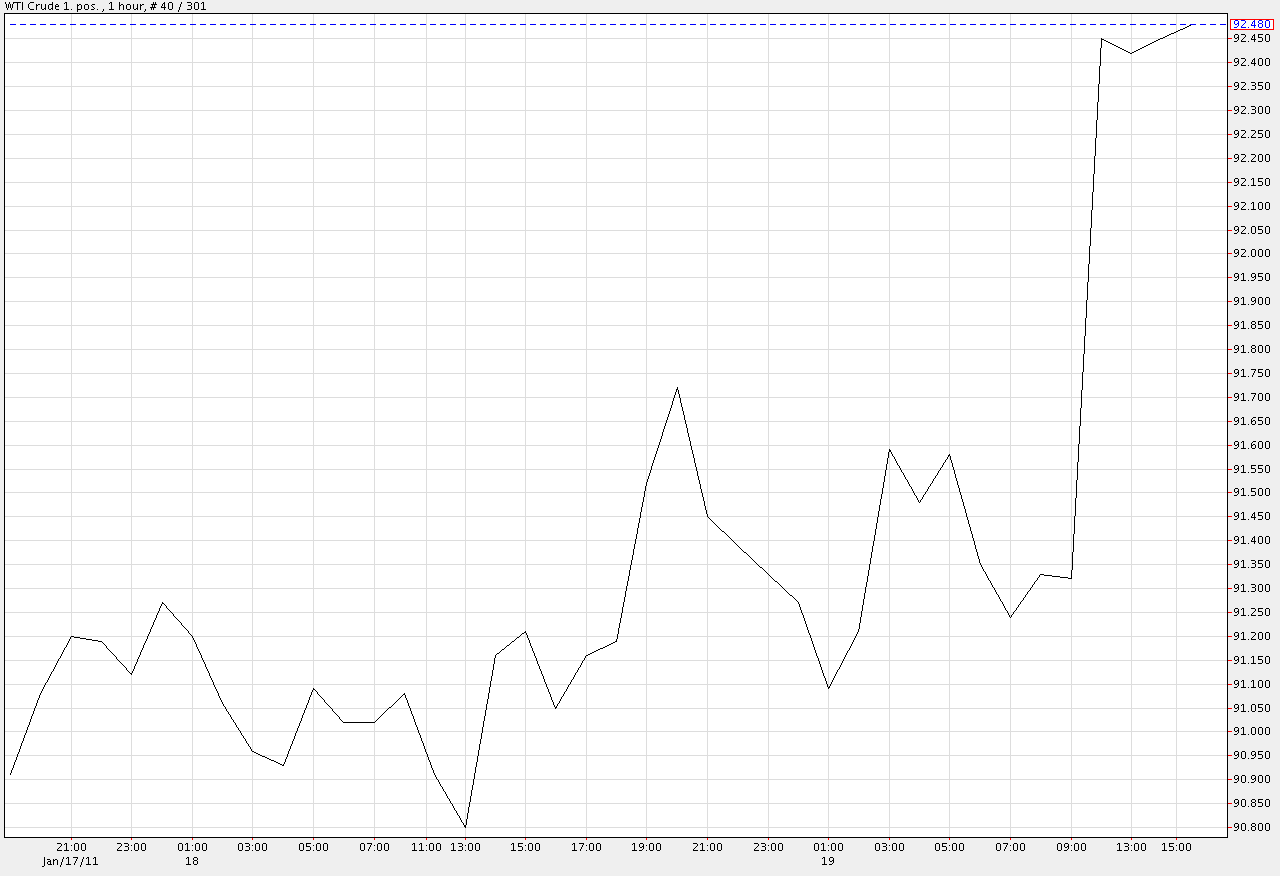
But the market gift to China (and everyone else), on increased risk appetite after the Portuguese bond auction, is the oil price:

Brent crude spiked to 98.80


and West Texas Intermediate now moving closer to 93 a barrel

Tuesday, January 11, 2011

China's inflation implosion 2011

With coal prices about to surge via Australia's devastating floods, a higher oil price will blow out Chinese companies operational costs. Mix that all up with China's inability to reign in domestic consumption inflation.

From NYT 12/01/2011

"In China, consumer prices were 5.1 percent higher in November than a year earlier, according to official government data. And many economists say the official figures actually understate the rate of inflation, which might in reality be twice as high.

“Four percent, China can bear it — beyond 5 percent, people will complain a lot,” said Huo Jianguo, president of the Chinese Academy of International Trade and Economic Cooperation here.

Higher global commodity prices, as well as rising wages in China, play roles in the increasing cost of Chinese goods. But economists say the main reason for the inflation now is China’s foreign exchange reserves, which surged by a record amount in the fourth quarter.

The central bank has been pumping out currency at an ever-accelerating pace over the past decade to limit the renminbi’s appreciation against the dollar. That strategy has helped preserve a competitive advantage of Chinese exporters by keeping their prices relatively low on global markets — while also protecting the jobs of tens of millions of Chinese workers in export factories.

Now, though, that cheap currency policy seems to be reaching its limits. The extra renminbi are feeding inflation. That is starting to undermine exporters’ price competitiveness — just as a stronger renminbi would do if Beijing was not intervening to begin with.

Money supply figures for December, which the central bank released on Tuesday, showed that cash and bank deposits were increasing at a rate twice as fast as even China’s soaring economy. Ever more renminbi are available to buy goods and services."

Monday, January 10, 2011

Japan and China will buy EU bonds using their FX reserves

Great plan. Asian FX surplus powerhouses will throw money at sovereign junk bonds of Spain, Ireland, Portugal, a slight lifeline on indebted addicts (PIIGS/Belgium) that refuse to restructure debt. Even so, if you bought a 'junk' bond, you buy that bond on the premise of the high yield to maturity, Japan/China may just push yields further as the junk bonds become more 'junk' as the rest of the markets, says ' sure it's all yours'.

Best part, when China/Japan/Asia go into a banking crisis via China's property markets crashing, by then they would have sucked out funds out of their FX reserves (losses) whilst holding EURO ZONE junk bonds as the quality diminishes against yield blowouts.

Bloomberg 11/01/2011


"The euro advanced for the first time in four days against the yen and Treasuries declined after Japan’s Finance Minister said it was appropriate for his nation to buy bonds to support Ireland. Asian stocks slid for a third day on speculation earnings growth will falter.

The euro traded at 107.44 yen as of 12:21 p.m. in Tokyo from 107.12 yesterday. Yields on 10-year Treasuries increased two basis points to 3.31 percent. The MSCI Asia Pacific Index fell 0.2 percent to 137, set for its longest slump in almost eight weeks. Standard & Poor’s 500 Index futures were little changed, with Alcoa Inc. retreating after reporting sales that missed analyst estimates.

Japanese Finance Minister Yoshihiko Noda is joining China in signaling support for Europe, where Portugal, Spain and Italy are preparing to borrow at least $43 billion this week amid a surge in bond yields. Alcoa, traditionally the first company on the Dow Jones Industrial Average to report earnings, posted sales that missed estimates even as aluminum prices surged amid a commodity rally that has fueled inflation concerns in Asia.

“Two key risks cited for this year’s markets are already with us now: renewed concern about indebted European nations and inflation in emerging economies,” said Lim Chang Gue, who helps oversee about $27 billion at Samsung Asset Management in Seoul. “Much of these were already known, but investors are worried that nobody knows how these issues develop and by what extent. Volatility may increase in the short term.”

Euro’s Rebound

The euro touched 106.83 yen yesterday, the lowest level since Sept. 14 and advanced today on speculation Japan’s bond purchases will ease Europe’s fund-raising crisis. The single currency erased losses against the dollar to trade at $1.2956 from $1.2951. Noda said at a news conference in Tokyo today that Japan will use its foreign exchange reserves to buy the bonds.

“It will support the financial markets,” said Kazuaki Oh’e, a debt salesman in Tokyo at Canadian Imperial Bank of Commerce, the North American nation’s fifth-largest lender. “The flight to quality is unwinding.”

Europe and the euro will remain among the most important areas of investment for China’s world-record $2.65 trillion of foreign-exchange reserves, Yi Gang, deputy governor of the People’s Bank of China said on Jan. 7. Vice Premier Li Keqiang last week also expressed confidence in Spain’s financial markets and pledging more purchases of that nation’s debt.

Stocks fell worldwide yesterday as the cost of insuring European sovereign debt against default jumped to a record. Dennis Lockhart, president of the Federal Reserve Bank of Atlanta, said he saw further “headwinds” for the U.S. economy in 2011. The Fed will release its Beige Book report on regional economic activity later this week.

Stocks Decline

MSCI’s Asian index was set for its lowest close since Dec. 30. Elpida Memory Inc. slumped 3.7 percent after the Nikkei newspaper reported the chipmaker’s quarterly operating loss may exceed 20 billion yen amid a decline in memory-chip prices.

Alumina Ltd., the Melbourne-based partner of Alcoa, sank 3.9 percent. Alcoa, the largest U.S. aluminum producer, reported fourth-quarter sales of $5.65 billion from $5.43 billion a year earlier, missing the $5.75 billion average estimate of seven analysts in a Bloomberg survey. The shares fell 1.7 percent after the close of regular trading in the U.S.

Suncorp Group Ltd., an insurer that gets 26 percent of its premiums from Queensland, declined 2.8 percent as rising waters in the Australian state headed toward the coastal city of Brisbane. The latest downpour killed at least eight people overnight, Premier Anna Bligh said on Sky News today.

Australia’s dollar depreciated against all 16 of its most actively traded counterparts and weakened to 98.66 U.S. cents from 99.56 yesterday. The currency also declined after the country’s statistics bureau said Australia’s trade surplus was A$1.93 billion ($1.9 billion) in November, compared with a revised A$2.56 billion a month earlier. The median estimate of economists surveyed by Bloomberg News was A$2.05 billion."

Sunday, January 9, 2011

Portgual soon to be bailed out by Germany/EU/IMF

Like Greece and like Ireland both went into a nonsensical denial as the bond and CDS markets forced them to accept reality. Portugal is next. In our planning 'style' current economic system, this means Portugal will be bailed out via the EU/IMF stabilisation fund, which is backstopped by German taxpayers that in turn needs China to keep supporting German exports.

A house of cards.

From Reuters:

SYDNEY, Jan 10 (Reuters) - The euro fell to four-month lows versus the dollar early in Asia on Monday after stops were triggered in thin trade as worries about Europe's debt crisis mounted.

The single currency fell as low as $1.2865 -- a level last seen in mid-September -- on talk that Portugal was under pressure from euro zone members such as Germany to seek financial aid. [ID:nLDE7080FG]

A Portuguese government spokesman on Sunday denied a German magazine report that Lisbon was under pressure from Berlin and Paris to seek a bailout from the European Union and International Monetary Fund. [ID:nLDE70808M]

The single currency also slid as deep as 1.2451 Swiss francs and 107.05 yen .

The euro was already under pressure last week as investors sold peripheral euro zone bonds ahead of a flurry of debt sales from the likes of Portugal and Spain this week. [ID:nLDE7061KW]

The dollar benefited from the euro's weakness, with the dollar index, which tracks the greenback's performance against a basket of major currencies, rising to five-week highs.

The index was last up 0.2 percent at 81.247, recovering from a dip to 80.7 following disappointing U.S. non-farm payrolls data on Friday

The closely watched report showed a rise of 103,000 jobs in November, short of economists' expectation for 175,000.